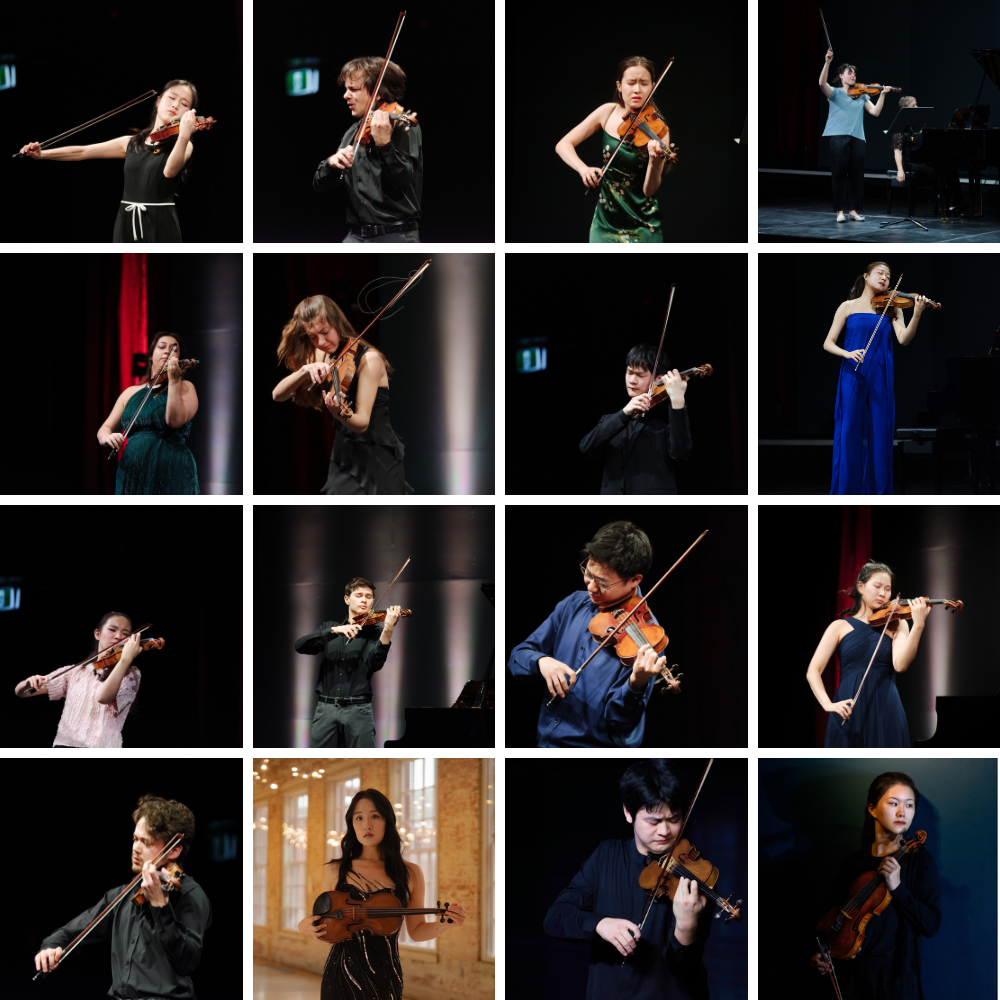


A feast of violin mastery: Highlights from Rounds I and II
If the first two rounds of the 2026 Michael Hill International Violin Competition have demonstrated anything, it is the extraordinary breadth of artistry emerging from the next generation of violinists. Across four days of performances, audiences in Queenstown have travelled across more than three centuries of music, from the architectural brilliance of Bach to newly commissioned New Zealand music, dazzling virtuoso showpieces, intimate sonatas and deeply personal artistic statements.
For listeners, the competition has offered an immersion in the many voices of the violin.
Bach: the equaliser
Round I opened with a challenge shared by almost every competitor: a movement pair from Bach’s Sonatas for solo violin. Whether performing the Adagio and Fugue from the First Sonata in G minor or the Grave and Fugue from the Second Sonata in A minor, Competitors were stripped of every safety net. The result was fascinating. Each violinist revealed not only their technical command but also their musical personality. Some approached Bach with poise and clarity, others with intensity and rhetorical drama. The contrapuntal complexity of the fugues became an early test of both concentration and imagination, giving audiences a rare opportunity to compare vastly different interpretations of the same masterworks.
Paganini, Ysaÿe and the art of the impossible
If Bach demanded structure and discipline, the solo virtuoso works required courage.
Paganini’s Caprices appeared throughout the opening rounds, with competitors tackling everything from the lyrical Caprice No. 2 to the fearsome No. 24. Audiences witnessed flying staccatos, ricochet bowing, left-hand pizzicato and finger-twisting passagework that continues to challenge violinists more than two centuries after the works were written.
Several performers went even further. Maxim Tzekov delivered Ysaÿe’s dramatic Third Sonata, “Ballade”, while Leanne McGowan and Yeonoo Jeong explored the contrasting worlds of Ysaÿe’s Fifth and Sixth Sonatas. Beatrice Colombis brought the powerful Second Solo Sonata by Grażyna Bacewicz in Round II, while Jakow Pavlenko ventured into one of the most notorious virtuoso works ever written, Heinrich Wilhelm Ernst’s Grand Caprice on Schubert’s Erlkönig.
These performances reminded audiences that virtuosity is not merely about speed. It is about storytelling under pressure, transforming technical feats into compelling musical narratives.
A new voice for violin
A defining feature of this year’s competition has been the prominence of the 2026 commissioned work, Chasm by Salina Fisher, which in many ways became a point of connection across the Competition. Audiences heard it interpreted in 16 different ways with each bringing different colours, pacing and emotional emphasis.
Some performances highlighted its atmospheric qualities, others its rhythmic energy and dramatic contrasts. By hearing the same contemporary work through multiple artistic lenses, listeners gained a unique insight into the interpretive choices that distinguish one musician from another.
Sizzling sonatas
Rounds I and II offered a remarkable survey of the violin sonata repertoire.
Listeners journeyed through the Classical elegance of Beethoven’s Op. 23, Op. 30 No. 3 and Op. 96 sonatas, the Romantic warmth of Brahms’s First and Second Sonatas, the lyricism of Fauré, and the emotional sweep of Franck’s beloved Sonata in A major.
French music featured prominently. Debussy’s late Sonata appeared in performances by Emmalena Huning, Maxim Tzekov and Yebin Yoo, each revealing different facets of its elusive, impressionistic language. Ravel’s Sonata and the gypsy-inspired fireworks of Tzigane brought brilliance and colour to several programmes.
The Russian tradition was equally well represented. Prokofiev’s First Sonata emerged as one of the most substantial works of Round II, performed by Beatrice Colombis, Yeonoo Jeong and Julia Wang. Its haunting atmosphere, icy sonorities and emotional depth provided some of the competition’s most gripping moments.
Elsewhere, audiences encountered the distinctive voices of Janáček, Lutosławski, Poulenc, Korngold, Grieg, Schubert, Szymanowski and Bartók, demonstrating the astonishing stylistic range required of today’s international violinists.
Moments of national identity
One of the pleasures of the opening rounds was hearing music that reflected the performers’ own cultural backgrounds and interests.
Hyein Koo introduced Korean composer Young-jo Lee’s Honzanori for solo violin, while Julia Wang performed Jingping Zhang’s celebratory Harvest Celebration. Xunyue Zhang brought Zhou Long’s Taiping Drum, a vivid work inspired by Chinese folk traditions.
Alexey Stychkin presented a contemporary fantasy based on Ukrainian folk themes, while Leanne McGowan championed Australian composer Margaret Sutherland’s evocative Nocturne.
These performances broadened the competition’s musical landscape and reminded audiences that violin playing today is a truly global art form.
Showpieces and spectacle
No violin competition would be complete without moments of pure exhilaration.
Saint-Saëns’s Introduction and Rondo Capriccioso dazzled in Hyein Koo’s programme. Wieniawski’s fantasy works appeared repeatedly, providing opportunities for grand Romantic display. Paganini’s I palpiti Variations tested Tianyou Ma’s virtuosity, while several competitors brought the flamboyant fantasy tradition to life through works inspired by Gounod’s Faust.
Ravel’s Tzigane proved especially popular, appearing in the programmes of Anaïs Feller, Jakow Pavlenko and Ruiyi Wang. Its blend of mystery, improvisatory freedom and breathtaking technical demands never failed to electrify the hall.
Looking ahead
By the conclusion of Round II, audiences had experienced an extraordinary panorama of violin literature.
As the competition moves into the chamber music and concerto rounds, the challenge changes once again. Solo brilliance must now be balanced with collaboration, communication and large-scale musical vision.
If the first two rounds are any indication, audiences are in for an unforgettable journey.