

Every competition, we commission a leading New Zealand composer to write a new work for violin which all quarter-finalists perform in the Queenstown quarter-finals.
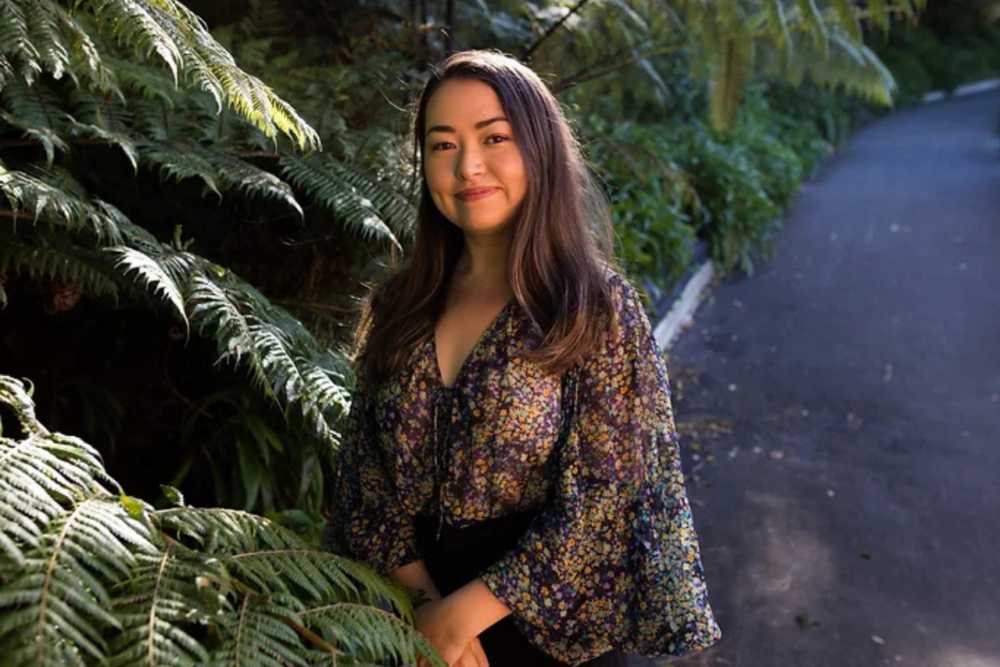
This year, the composer is the award-winning Salina Fisher, also a violinist. We had a chat to Salina about Chasm…
Tell us about Chasm – where did the inspiration come from?
Chasm is inspired by both meanings of the word: a deep fissure in the earth’s surface, and a profound divide between people. Visiting Patuna Chasm near Wellington, literally standing inside a split through the land, was a moving experience that led me to reflect on the word’s other meaning. In a world that feels increasingly fractured, this piece emerged from a deeply personal desire to navigate that feeling.
Chasm opens with a unison note that fractures, splitting into two voices. The entire work grows out of this idea, including a lamenting melody set against and around the grounding of the open string. What unfolds is rhapsodic and intense, lyrical and questioning, sometimes withdrawing into contemplation and other times intensifying into something more anguished and virtuosic. There is a sense of wrestling with something that cannot be resolved. The violin’s timbre frequently shifts from a rich expressivity to harsher, transparent tones. Eruptions into passages of fierce virtuosity never fully resolve. Ultimately the music opens out, as if looking up from within the fracture.
How long does the writing process take for you for a five-minute piece like this?
I’ve been thinking about the piece for a long time; I was first asked about it back in 2019 (!) and it’s so exciting that it’s all happening now.
I’ve loved hearing all the past New Zealand composers’ MHIVC pieces over the years, including John Psathas’s incredible Gyftiko – I remember him talking about it during my first year as his student at NZSM back in 2011, alongside my then violin teacher Martin Riseley. More recently, my other former teacher Michael Norris wrote the beautiful Waipounamu for the last competition in 2023.
It’s a huge honour to be contributing to this important MHIVC legacy of New Zealand violin compositions, and also rather daunting! It takes me a long time to think about and plan a piece, even if the actual writing of notes comes down to the last few months. It might sound strange, but I really think that composing a solo violin piece is just as hard, or possibly even harder, than writing for a full orchestra. A very different challenge.
Where do you write?
I write in my apartment in central Wellington. There’s nothing particularly interesting about the space itself… Just a desk, my violin, laptop + monitor, some pencils and paper. Usually a pot of tea, and occasionally a candle.
What’s the process for creating a new work for the Competition – I understand you ran it past Andrew Beer before completion to see how it played, from his perspective. What’s the process there?
Yes, that’s a unique part of the process for this commission. Andrew Beer, on behalf of the panel, checks the piece for its suitability before it’s made available to the competitors. The new piece has to challenge them in some way, difficult but playable, as well as clear/accurate in terms of its notation. I’ve worked with Andrew many times over the years – his eye for detail is unmatched and I am always very grateful for his feedback. On this occasion, there were just a few notational things to fix up, and to clarify with performer notes.
I played my violin a lot as I was writing it. I always consider playability when I’m composing, so usually it’s an advantage to have that perspective. But in writing a piece that needs to challenge some of the world’s top young violinists, I’m not so sure. I’ve tried my best not to let my own abilities limit what I write. I can kind of play it, but it would take a lot of practice to play it very well! The piece does have some virtuosic elements, but I wouldn’t say that’s the focus necessarily – it will definitely provide some different challenges from their other repertoire.
What will the violinists find most tricky, do you think? What do you hope they will enjoy?
I’m not sure exactly how much contemporary music, or NZ music, each competitor will have encountered before this competition. Alongside their more familiar repertoire, I really hope the players will find it stimulating and meaningful to prepare and perform a brand new work that has been created right here in Aotearoa. It’s an emotionally intense piece, and while yes there are a number of sounds/techniques that could be new for some players, I would say the greatest challenge with this piece will be more musical than technical. It was a huge emotional challenge to write the piece, it really affected me deeply, so I can imagine that will be challenging to interpret and convey. I would be extremely impressed if anyone manages to memorise it – it’s very detailed. I genuinely hope they will enjoy getting stuck into Chasm. I’m very excited to hear all the different interpretations.
What is your ultimate objective when creating a new work for solo violin? That the audiences and the players love it, of course, but are there others?
There’s something so intense and intimate about solo violin playing. Just one person, with one small but mighty instrument, capable of multiple voices. Compared to the piano, for example, with its keys and sustain pedal, the violin is so bare, and extremely sensitive to even the tiniest possible movement. There’s also a lot more flexibility in terms of pitch and timbre to work with.
When I write, I think a lot about the whole experience of its performance, including from the perspective of both performer and listener. I consider the instrument itself, its sonic possibilities, and through that how to express and explore something meaningful in a musically authentic way. Because I play the violin, I would say string writing is my timbral comfort zone, but stretching that in a technical/virtuosic way is definitely a challenge. Whatever the instrumentation, I’m always aiming to write music that is meaningful, beautiful, relevant, authentic, and new. Those can all mean different things in different contexts.
How does it fit into your wider body of work? Are there any musical or thematic similarities?
My music often relates to the natural world in some way, and this is also not the first time I’ve been drawn to a word’s different meanings. Chasm is more about the latter than the former. Of my wider body of work, it feels most closely related to my viola piece Reflect, which was also an intense emotional release, and interestingly also for a solo string instrument. There is definitely something unique and intense about the possible emotional journey in a solo string work, as a kind of monologue, compared with the conversational and layered nature of chamber/ensemble pieces.
Anything else you’d like to share?
It’s so special that the competition is hosted here in Aotearoa, and I’ve felt for many years that the inclusion of a new NZ work provides an important and exciting musical link to the place. It’s a huge honour and privilege to be in this position this year. I’ve put my heart and soul into Chasm, and am so excited to hear it and meet everyone soon in Queenstown. I appreciate the incredible level of dedication involved in preparing for a competition like this, and am wishing everyone the very best!